AI UGC vs Agency vs DIY: Buy the Production Your Proof Needs
23 of 56 real-video references selected for AI UGC: what that review showed, what our demo missed, and how agency production compares with DIY.
Jump to
What is AI UGC?When should you use AI, an agency or DIY?What did our reference selection actually show?Does AI UGC actually work?Can AI UGC show a real product accurately?Is AI UGC cheaper or faster than an agency?Is AI UGC legal?What rights and delivery terms belong in the comparison?How should you compare an agency, a marketplace creator and AI?When should you avoid these options?Frequently asked questionsUse AI UGC for approved explanations around accurate proof, real creators for product handling and lived experience, and an agency when coordinating recurring production is the gap. Test a complete adaptation before commissioning variations.
At EntireFeed, we checked 56 real source videos as references for AI-assisted ads: a person reacts, then the video moves into a real product demonstration. Independent review approved them for that editing format. Our founder wanted to use only 23, including none of the 15 ecommerce examples.
That gap matters when you commission an adaptation. A usable demo clip can still be the wrong reference for your brand. Approve the full opening-to-demo sequence before paying to reproduce it.
What is AI UGC?
AI UGC is AI-generated creator-style video made to resemble user-generated content, using a synthetic presenter or performance. The label describes a production method, without establishing a real customer's experience: our example combines generated surrounding footage with a recorded interface, and an accepted export still needs review.
When should you use AI, an agency or DIY?
Choose around the evidence your video must show and who can manage production. Real product handling calls for real footage. A synthetic presenter can explain approved information around that footage. An agency can coordinate either method; DIY and marketplaces leave more of the coordination with your team.
| Need | Useful starting point | What you must still own or buy |
|---|---|---|
| Genuine product use or a customer's experience | Real creator, customer or your own filming | Access to the product and support for the claims |
| Explanation beside an accurate software demo | Real screen recording with a human or AI presenter | Recording, script-to-screen alignment and editing |
| Recurring casting, briefing and review | Managed agency production | A clear scope and buyer approval |
| Limited filming with a capable internal editor | Direct creator or marketplace | Briefing, permissions and footage acceptance |
Ask who does each job before comparing prices. In her January 2026 production talk, at 2:39–6:05, Savannah Sanchez separates strategy, raw-footage creation and editing. You can buy those roles together or assemble them yourself. With direct hiring, your team owns casting, the brief, product delivery, feedback, editing and permission tracking unless the agreement assigns them elsewhere. Ask an agency who takes each task and who approves footage each week.
What did our reference selection actually show?
Our reference review showed a gap between format approval and buyer selection, before any adaptation or ad test.
On October 17, 2026, our reference-library review covered a specific job: replace the opening reaction with an AI-generated performance, then transition into the real demonstration and a call to action.
“Passed” meant the reviewer judged the demo footage usable for that edit: it demonstrated an identifiable product or feature, had a usable entry point, and had an ending that could be retained or given a new call to action. Some clips had editing conditions attached. This was approval of source material, before generating an adaptation or testing an ad. Our founder then made these selections:
| Category | References reviewed | Selected |
|---|---|---|
| Mobile apps | 15 | 11 |
| SaaS and AI tools | 15 | 9 |
| Ecommerce | 15 | 0 |
| iGaming | 11 | 3 |
| Total | 56 | 23 |
That left 23 selected and 33 rejected. No rejection reasons were saved. These counts tell us which references our founder wanted for this brief; they cannot explain the category differences or predict AI quality or sales.
The practical question is where the product proof comes from. For a software walkthrough, a real recording can show the feature while a generated opening supplies presentation. That makes the combination worth trying on your own product. For ecommerce, the sale may depend on fit, texture, handling, assembly or a visible result. Capture those details with the real product, then decide whether a synthetic presenter adds anything. Our zero ecommerce selections do not establish that AI cannot work there; they show why approval of a general style leaves the buying decision unfinished.
Before ordering a batch, approve a complete reference with the person who will accept delivery. Write down what they are approving: the opening performance, the transition, the visible product action and the ending. Then commission one complete adaptation. A folder of attractive references leaves too much unresolved.
Does AI UGC actually work?
AI UGC attracted more viewing but fewer interactions in a September 23, 2026 study by Edwin Arango-Espinal, Augusto Rodríguez Orejuela and Paula Andrea López-Herrera: the AI-avatar condition had 25% more quarter-length plays and 38% fewer clicks (all) than the human condition in its main count models. The enquiry result was inconclusive.
Sections 3.4 and 4.2 explain the measures. A play meant reaching a quarter of the video, including autoplay and repeats. “Clicks (all)” included reactions and expansions as well as destination clicks. Neither measured purchases.
For illustration, normalize each human measure to 100: 100 × 1.25 = 125 quarter-length plays; 100 × 0.62 = 62 all-click interactions. These are rescaled comparisons, not observed campaign totals. Picking a winner by viewing alone would overlook the opposite movement in interaction.
The campaign concerned Colombian higher education, used one human and one synthetic presenter, and relied on algorithmic delivery rather than assigning users randomly to creative conditions. The study supplies no settled conversion verdict.
For your pilot, choose the downstream outcome before launch: a qualified enquiry, trial activation or purchase. Record viewing and destination clicks alongside it. Keep product, offer, message and destination comparable so you can interpret the result. A viewing advantage alone is insufficient grounds to replace your creator programme.
Can AI UGC show a real product accurately?
A recorded interface can supply product evidence inside a generated scene. In our October 2026 tools-page experiment, we generated the hand-and-device shot, then composited a real screen recording into its display.
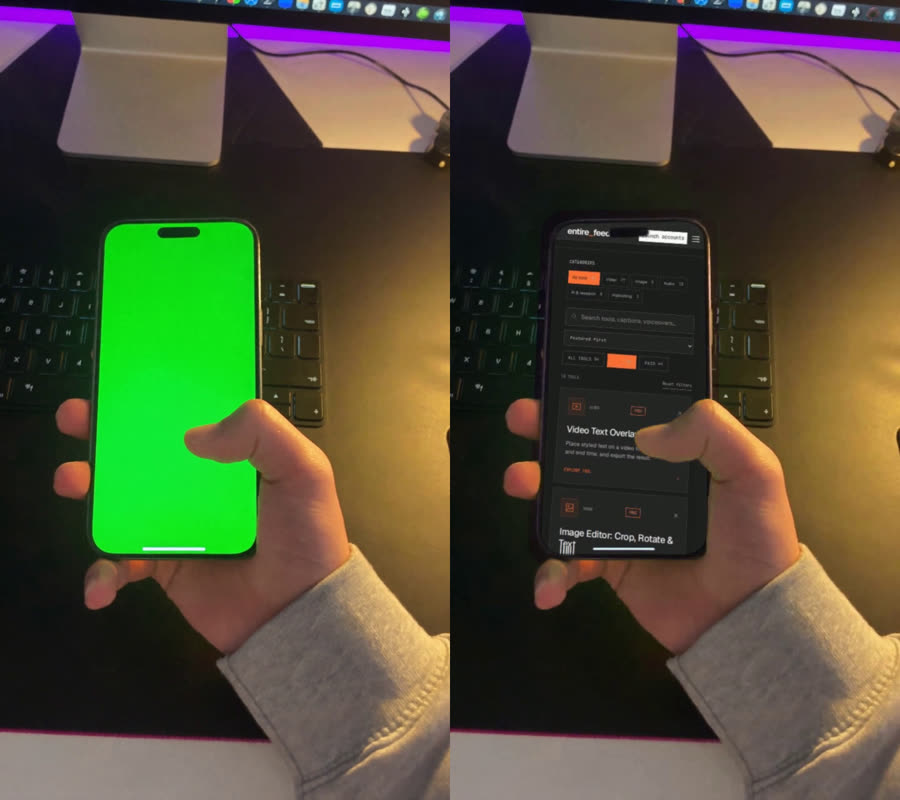
The recording supplies the interface pixels. The generated shot supplies the surrounding appearance and movement. This preserves recorded interface behaviour inside a synthetic scene; it does not establish that the depicted hand operated the app.
Watch the actual composited demo segment.
The hook-writing step exposed another mismatch: the model preferred a line about an image editor that our demo never opened. We chose a line about the free-tool filter visible from the opening frame. A true product fact can still be the wrong claim for the footage. Before approving the script, ask the writer to point to the recorded action that supports each demonstration claim.
Use the demo segment to inspect the production boundary. Watch whether the display stays aligned, fingers overlap correctly and apparent actions match what happens on screen. A real recording can still be placed into a confusing or inaccurate sequence.
Our assessment of this experiment was “OK, not great.” We had a demo segment, with no finished reaction ad: the adapted reaction prompt was unrun, and the assembly check used a still in its place. No advertising performance was measured. Use the clip to judge the compositing approach; ask a vendor for a complete export with audio before agreeing to recurring production.
Is AI UGC cheaper or faster than an agency?
A subscription price alone cannot tell you whether an accepted export will be cheaper or faster than agency production; compare the entry prices against the work they buy. These vendor offers were checked October 23, 2026; they are not equivalent production quotes or EntireFeed prices.
| Route | Public entry price | Remaining cost or commitment |
|---|---|---|
| Creator video | Billo: from $99, creator pay included; managed service from $2,000/month | Prepaid purchase, shipping, extras and your team's remaining work |
| Marketplace | Insense Brand: from $500/month, billed $1,500 quarterly | Separate creator payments and 10% marketplace fee |
| AI presenter tool | HeyGen Creator: $29/month with 600 credits | Generation consumption, failed attempts, finishing and review |
Billo's prepaid balance pays for its orders; count those video charges once and track unused credit separately. HeyGen's credit consumption varies by model, duration and generation type. A subscription price cannot establish a cost per accepted ad. For a retainer, check the reserved capacity, included revisions and what happens when approvals delay production.
Which video generator should you pick?
Use HeyGen's published Creator offer as a tool-cost starting point, then compare a complete export against your actual brief. Ask any AI video generator supplier about commercial rights, credit consumption, failed generations and finishing. The evidence here does not compare Arcads or Creatify, so it cannot rank their output quality.
Include finishing and review in the comparison
Generating another performance can avoid a new casting or shipping cycle when no physical shoot is needed. The final asset can still require compositing, cut selection, audio work and review. Ask for time to an accepted export, including those steps. Have the supplier state what restarts that clock: a changed script, reshoot, faulty recording or new product screen.
In a separate EntireFeed production run on October 20, three private samples passed an initial automated review. A fresh reviewer requested changes to all three, including hand-edge, colour and cut problems. The fixes used editing and compositing while the recorded generation-credit total stayed unchanged. Some needed further rounds, and the last repair did not receive another fresh reviewer pass.
That is a concrete reason to ask which work a retry fee buys. A new render may leave a compositing defect untouched. Diagnose the failed stage, then price the correction. We did not log enough labour to claim a cost saving from those repairs.
Compare the routes using the same calculation:
Cost per accepted asset =
(production + tools + rights + editing + all review and repair labour)
/ assets accepted for the intended use
For DIY, include your own team's work. For marketplaces, include briefing, creator selection, shipping and permission tracking. For agencies, reconcile the bundled scope. For AI, include failed attempts and finishing work. Acceptance means the file meets the agreed use; campaign results are evaluated afterwards.
Is AI UGC legal?
The FTC's Q&A says AI avatars are not categorically banned under the US testimonial rule, but fake or false underlying testimonials remain prohibited. Avatar use can also be deceptive under the FTC Act; this guidance does not establish that a particular ad is lawful.
TikTok's AI-ad policy, checked October 23, distinguishes significant synthetic changes from minor enhancements. Fully generated media and making someone appear to say or do something they did not require its prescribed label or disclaimer. Listed minor edits include lighting, colour and noise cleanup.
Have the supplier identify synthetic elements and include the destination's required disclosure in delivery. Cleaning a human recording and replacing the speaker create different review tasks.
The underlying experience must be truthful with actors and AI avatars alike; a real actor or an AI label cannot establish that someone used the product. Keep spokesperson explanations separate from claims of personal results.
What rights and delivery terms belong in the comparison?
Get a written handoff covering raw footage, finished files, ownership or licence, permitted channels, territories, duration and editing. State whether your agency or client can keep using the material after the engagement. Specify any proposed AI reuse of a creator's voice, likeness or performance separately.
Creator posting and permission to advertise through their identity are additional scope. Assign renewal responsibility and record permission dates alongside the files. A tool subscription alone does not answer those questions.
For each route, agree revision limits, correction versus new scope, delivery and approval deadlines, cancellation and renewal. Ask who pays when the output misses an approved requirement. Price the complete usable delivery before committing to recurring production.
How should you compare an agency, a marketplace creator and AI?
Give each supplier the same product facts, visible proof and intended destination. Approve the method before the pilot, then use this filled example for a software demo:
Job: explain the feature shown in our supplied screen recording.
Reference: approve the complete opening-to-demo sequence before scaling.
Proof: use the recording for product UI and actions.
Presenter: state whether human, synthetic or recast; confirm permissions.
Script: claim only what the supplied recording and product facts support.
Acceptance: accurate sequence, readable screen, clear audio,
coherent transitions, agreed usage and required disclosures.
Review: watch the full export with sound, including the ending.
Record: cost, time to acceptance, repair requests and their causes.
Paid test: agree the downstream outcome and media budget separately.
Choose a bounded pilot and name the final approver. Approve the reference, script and method before production, then review the full export before ordering variations. Compare truth, visible demonstration, delivery and pronunciation, visual continuity, and readiness for the destination.
The review record should identify the actual file and the moments checked. Ask a reviewer to point to the product action and the transition they inspected. A general approval paragraph is less useful than a review you can follow back to the video.
After production acceptance, keep viewing, destination clicks and the downstream outcome separate in the report. Include dates, spend and the actual assets tested; record remaining differences rather than assigning every result to human versus AI.
Compare the accepted pilots on your own production constraints. An internal editor may make direct hiring workable; recurring casting and review may justify agency coordination. Repeated approved explanations may suit AI. Let the complete sample expose the work each proposal leaves with you.
For hiring, cost reconciliation and permission tracking, use the UGC agency buyer's guide. EntireFeed's short-form content agency service covers planning, making and posting for brands.
When should you avoid these options?
Avoid synthetic demonstrations when real physical behaviour is the evidence you need and you have no real footage. Avoid a retainer while the buyer still rejects the proposed production style. Avoid DIY when nobody has time to brief, review and finish the work.
For production or publishing capacity that helps your agency handle more business while keeping control of clients and quality, use the contact block below to discuss a complete reference and intended use with EntireFeed.
Frequently asked questions
Settle production scope and permissions, then approve a complete adaptation before ordering variations.
Is an AI UGC agency a different kind of agency?
It describes the production method. Ask which roles the service covers and which parts of the delivered video will be synthetic.
Can I combine a real creator with AI?
Yes. Define the recorded and generated parts, obtain the relevant permissions and check the complete sequence against the product facts.
What should I approve before ordering variations?
Approve the reference, then a complete adaptation with your actual product evidence. Record why you accepted it so the next batch has a usable brief.
Doing this across many accounts?
EntireFeed makes short-form video at volume and posts it on real TikTok, Instagram and YouTube accounts. Tell us what you are posting and where, and we will say plainly whether we can help.